The one change that prevents most breakage
Almost everyone stacks plates flat, because that is how they sit in a cupboard. A cupboard is stationary. A van is not.
When plates lie flat, the bottom plate carries the weight of every plate above it, and it absorbs every jolt through its widest, weakest surface. One hard stop, one kerb taken badly, and the crack runs through the whole stack. Stood on edge, each plate takes road shock through its strongest axis and none of them carries the others.
| What people do | What happens | What to do instead |
|---|---|---|
| Stack plates flat | The bottom plate takes all the load and cracks the stack | Stand them on edge, tightly packed so they cannot tip |
| Use a large box because it holds more | It gets too heavy to carry safely and gets dropped | Small or dish-pack boxes, filled to a weight you can carry |
| Leave gaps at the top | Contents shift and knock together in transit | Fill every gap until a gentle rock produces no movement |
| Wrap in newspaper | Ink transfers onto glaze and glass | Clean packing paper, or wash everything after unpacking |
| Put the dish box at the bottom of the load | Furniture and heavy boxes crush it | Dish boxes ride on top, never underneath |
Why an edge is stronger than a face
This is why the vertical method is standard among removal crews rather than a preference. It is not about being careful, it is about which direction the force runs.
Two consequences follow from that, and both matter more than the wrapping:
- Nothing should carry anything else. Once plates are on edge, no single piece is bearing the weight of the pile. Add a stack of bowls on top of them and you have undone it.
- Movement is the enemy, not impact. A box that shifts internally for an hour does more damage than one firm knock. Packing tight is as important as packing soft.
What you need before you start
| Item | What it is for | Can you skip it? |
|---|---|---|
| Clean packing paper | The layer that touches the glaze. Newsprint without ink | No. This is the one that matters |
| Small or dish-pack boxes | Dish packs are double walled and take the load. Small boxes limit weight | Not really. A thin grocery box will fail at the base |
| Cell dividers | A cardboard grid so glasses never touch each other | Yes for plates, no for glassware |
| Bubble wrap | An outer shock layer for crystal, china and anything irreplaceable | Yes for everyday plates |
| Strong tape and a marker | Sealing the base properly, and labelling | No |
Tape the base of every box across the seam and then again at right angles before you put anything in it. A dish box that fails does so at the bottom, usually while someone is halfway down a flight of stairs.

The method, plate by plate
Work through it in this order:
- Line the base. Two to three inches of crumpled paper in the bottom of the box, so nothing sits on a hard surface.
- Wrap the heaviest plates first. Put one plate in the centre of two or three sheets, fold a corner over the face, then roll the plate away from you, tucking the sides in as you go. You are making a paper parcel, not draping a sheet over it.
- Bundle three or four. Stack the wrapped plates together, then wrap the whole bundle in another two or three sheets. Do not bundle more than about five, because the bundle gets heavy enough to be awkward.
- Stand the bundles on edge. Slot them in vertically, side by side, like files in a drawer. They should be snug enough not to tip but not forced.
- Fill every gap. Crumpled paper down the sides, between bundles and across the top.
- Do the rock test. Close the box, lift it slightly and rock it gently. If you hear or feel anything move, open it and add more paper. This test is the whole quality check.
Bowls behave differently from plates. Nest two or three with paper between them, wrap the group, then set the bundle on edge like a plate. Lids come off and get wrapped separately, never left sitting loose on the dish they belong to. Large platters are simply oversized plates: wrap well and stand them on edge against the side of the box.
Glassware is a different problem
The technique changes because the failure mode changes:
- Stuff the inside first. A crumpled sheet inside the bowl of each glass supports it from within.
- Wrap the outside separately. Two or three sheets around the body.
- Stemware needs a third step. Wrap the bowl, then wrap the stem and base again on their own, building a thicker layer around the stem, which is where wine glasses and flutes almost always snap.
- Slot each one into its own cell and stand it upright. No glass should be able to reach another.
- Heaviest at the bottom, most delicate at the top, within the same box.
If you have crystal or anything genuinely irreplaceable, use paper against the surface first and bubble wrap over the top. Paper prevents scratching, bubble wrap absorbs shock, and they are doing two different jobs rather than competing.
The weight limit nobody in a tenement flat can actually use
This is where the international advice and the Edinburgh reality part company. Nearly every well-ranked guide on this topic is written for a house with a driveway and a truck parked outside. Most of this city lives up a stair.
A 20kg box is manageable across a kitchen floor. It is a genuinely different object at the turn of a half-landing, where you cannot see your feet, the wall is close on one side and the handrail is close on the other. That is the moment a grip gets adjusted, and a dropped corner cracks plates that were packed perfectly.
The practical rule we work to:
- Use the carry test, not the scales. If you cannot pick the box up and carry it the length of a hallway without shifting your hands, it is too heavy for a stair.
- Fill the top with something light. If a box still feels light with plates in it, add linens or crumpled paper rather than more china. More boxes is always cheaper than more breakages.
- Label the top face and one side. On a stair, the top of a box is often the only face anyone can see while carrying it.
- Never pack a fragile box you cannot lift alone, because the moment where two people renegotiate a grip on a landing is the moment it goes.
This is one of the specific things our crews measure at survey, and it is why packing services in Edinburgh exist as fragile-only bookings rather than all-or-nothing. Most households genuinely do not need their books packed. They need the kitchen done by someone who packs kitchens every week.
Labelling and loading, which is half the job
What to write, and where:
- FRAGILE and THIS WAY UP on at least two sides, one of them the top.
- The room it is going to, not the contents. “Kitchen” gets it to the right place. “Plates” does not.
- A note if it holds anything irreplaceable, so it can be carried separately rather than stacked at all.
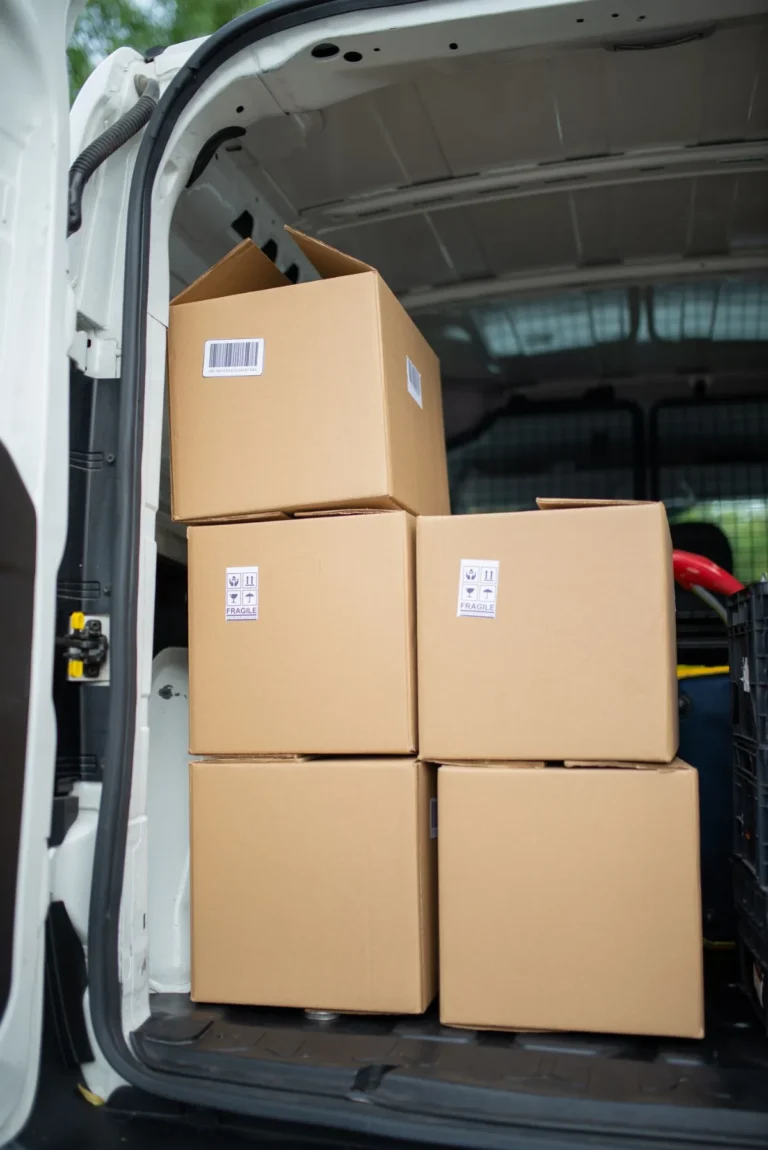
On loading, the rule is simple and frequently ignored: dish boxes go on top of furniture and heavy cartons, never underneath. If you are packing yourself and a crew is loading, tell them which boxes are the fragile ones before they start, not while they are lifting.
The same logic runs through the rest of the kitchen. Appliances have their own sequence, and a fridge freezer in particular needs handling that starts days before the van arrives, which we cover in our guide to moving a fridge freezer.
When packing them yourself is the wrong call
Cases where we would tell you to hand it over:
- Inherited china, crystal or a full dinner service. The value is not replaceable and the packing standard needs to be higher than paper and hope.
- If cover matters to you. Check how your removal firm’s insurance treats owner-packed cartons before you decide, because the distinction is common and it usually only surfaces after something has broken.
- If you are packing the night before. A kitchen done properly takes hours. A kitchen done at eleven at night is where the shortcuts happen.
- If the flat has a difficult stair, because the carry is the risky part and it is worth having people doing it who do it daily. It is quoted as part of house removals in Edinburgh rather than as a separate job.
Equally, cases where you should not pay anyone:
- Everyday plates and mugs from a supermarket. If a plate costs less to replace than to have professionally wrapped, wrap it yourself and accept the odd loss.
- Anything chipped or cracked already. A move is the best decluttering deadline you will ever get. Do not pay to transport something you would throw out in September.
Common questions about packing plates and glassware
Should plates be packed flat or on their side?
On their side, standing on edge like records in a crate. A plate is strongest across its edge and weakest through its face, so vertical packing sends road shock through the strong direction and stops any single plate carrying the weight of a stack. Flat stacking is the most common cause of cracked dinnerware.
How do you pack plates without bubble wrap?
Clean packing paper is sufficient for everyday crockery. Wrap each plate individually, bundle three or four, wrap the bundle again, then stand the bundles on edge with paper filling every gap. Bubble wrap is a second layer worth adding for crystal, fine china or anything irreplaceable, rather than a requirement for ordinary plates.
Can I use newspaper to wrap plates?
You can, but the ink transfers onto glaze and glass, so everything needs washing after you unpack. Clean newsprint without ink costs very little and saves running the entire kitchen through a dishwasher on the first evening in a new home.
How heavy should a box of plates be?
Published guidance commonly caps a dish box at around 20kg. In a flat with stairs, use the carry test instead: if you cannot lift it and walk the length of a hallway without changing your grip, it is too heavy to take down a tenement stair safely. Use more boxes rather than fuller ones.
How do you pack wine glasses so the stems do not snap?
Wrap in two stages. Pack a crumpled sheet inside the bowl, wrap the bowl, then wrap the stem and base separately with another sheet so the stem carries the thickest layer. Stand each glass upright in its own cell divider so nothing touches. The stem is the failure point, so it gets the extra material.
How do I know a box is packed properly?
Close it, lift it slightly and rock it gently. If anything shifts, slides or clinks, there is a gap that needs filling with crumpled paper. Movement over an hour in a van causes more breakage than a single knock, so a box that makes no sound when rocked is a box that will arrive intact.
Before you start on the kitchen
Get the materials in first, work through one cupboard at a time, and rock-test every box before you tape it shut. Pack a labelled box of a few plates, mugs and cutlery to travel with you, because unpacking twenty boxes at midnight looking for a teaspoon is a rite of passage worth skipping.
More practical guides to moving in and around this city are collected in our Edinburgh moving guides.
Packing technique in this guide reflects standard removals practice and published guidance from professional movers and packing suppliers, reviewed on 3 August 2026. Insurance treatment of owner-packed cartons varies between firms and policies; check yours before deciding what to pack yourself.